Modern Boat Lifts: New Technologies Transforming Waterfront Docking
Boat lifts have traditionally served a straightforward purpose: keeping boats safely above the water when not in use. However, modern boat lift technology is evolving, with new designs offering faster operation, improved accessibility, more discreet mechanical systems, and even solar-powered options.
Some of the most interesting developments are changing the relationship between the boat and the dock itself. Imagine a section of your dock that supports your boat, lowers into the water for launching, and rises again to become part of the surrounding waterfront structure.
These innovations are already appearing in commercially available boat lift systems, while emerging technologies suggest even more possibilities for future electric boathouses.
Traditional Boat Lifts: Where It All Began
Conventional boat lifts generally use cables, pulleys, electric motors, and supporting cradles to raise boats above the water.
Vertical, cantilever, and elevator-style lifts remain common solutions for residential waterfront properties. Their primary advantages include reducing continuous hull exposure to water, limiting marine growth, and providing easier access for maintenance.
However, traditional installations often require visible support structures, mechanical equipment, and routine cable inspections.
Modern alternatives are addressing some of these limitations through streamlined designs, improved controls, and different approaches to lifting and supporting boats.
Hydraulic Boat Lifts: A Modern Approach

Hydraulic boat lifts use pressurized fluid to operate lifting mechanisms, providing an alternative to conventional electric winch systems.
One recent example is Sunstream’s Helix2-P, introduced in March 2026. This piling-mounted hydraulic lift features a minimalist design, reduced visual obstructions, and improved accessibility between the boat and dock.
The manufacturer reports that its design can accommodate a gap as small as four inches between the boat and dock under suitable installation conditions.*1
Modern hydraulic systems may also incorporate battery power, wireless controls, and automated lifting functions.
For waterfront homeowners, these features can improve convenience while helping preserve unobstructed views.
Hydraulic lifts still require proper maintenance, including inspection of hydraulic components, seals, connections, and corrosion-prone hardware.
Submersible Platform Lifts: When the Dock Becomes the Lift

One of the most interesting innovations is the submersible platform boat lift.
Rather than supporting the boat on a conventional exposed cradle, certain systems incorporate a walkable platform that lowers into the water with the boat.
Hurricane Boat Lifts offers a platform system in which the entire deck lowers for launching and retrieving the vessel. The manufacturer describes features including automatic leveling, remote operation, flow-through decking, and a locking mechanism that stabilizes the platform when raised.*2
This configuration can provide more convenient access around the boat for boarding, loading equipment, cleaning, and maintenance.
When fully raised, the platform can visually integrate with the surrounding dock, creating a more unified waterfront appearance.
It is important to distinguish the platform configuration from its lifting mechanism. Hurricane’s published specifications identify a direct-drive gear system rather than a hydraulic mechanism.
Other manufacturers use different approaches to submersible docking.
Jet Dock’s Performance Boat Lift Dock incorporates a drive-on design with a submersible stern section, allowing boats to be launched and retrieved from a floating platform.*3
Although these designs operate differently, both demonstrate how boat lifts and docks are becoming more integrated.
For a future electric boathouse, a platform-based installation could provide an attractive foundation for additional technologies, including automated controls and integrated power systems.
Floating Boat Lifts: Greater Flexibility on the Water

Floating boat lifts offer another approach to keeping vessels above the water without relying on conventional fixed lifting structures.
Sunstream’s FloatLift combines buoyant pontoons with hydraulic mechanisms to lift and support a boat. According to the manufacturer, the system can operate in relatively shallow water and offers remote operation, smartphone connectivity, and optional solar charging.*4
Floating systems can be particularly useful where water levels fluctuate or traditional piling-mounted installations are impractical.
However, installation requirements vary depending on water depth, wave conditions, anchoring arrangements, and the boat’s dimensions.
The ability to adapt to different waterfront environments makes floating lifts another important development in modern docking technology.
Solar-Powered Boat Lifts: Available Today

Solar-powered boat lift technology is already available in certain commercial systems.
Rather than supplying power directly to a large lifting motor, these installations typically use solar panels to recharge batteries that operate the lift.
Sunstream’s FloatLift, for example, offers solar charging for its battery-powered hydraulic system.*4
Another innovative design is Sunstream’s LiftBar.
Unlike conventional cable-winding equipment, LiftBar incorporates a ball-screw-based lifting mechanism enclosed within a low-profile aluminum housing. Its battery system can receive a maintenance charge from solar power, reducing dependence on conventional dockside electrical charging.*5
The enclosed design also allows the lifting components to be integrated more discreetly into certain dock configurations.
These developments demonstrate that solar power can support practical waterfront equipment beyond lighting and security systems.
However, a solar-powered boat lift should not be confused with a solar system capable of charging an electric boat’s propulsion batteries. The energy requirements are substantially different.
A well-planned electric boathouse could accommodate both systems, using appropriately sized solar equipment, batteries, and electrical infrastructure.
The Future: Smart, Solar-Integrated Boat Lifts

Looking beyond today’s commercially available products, boat lift technology presents interesting opportunities for further integration with modern waterfront architecture.
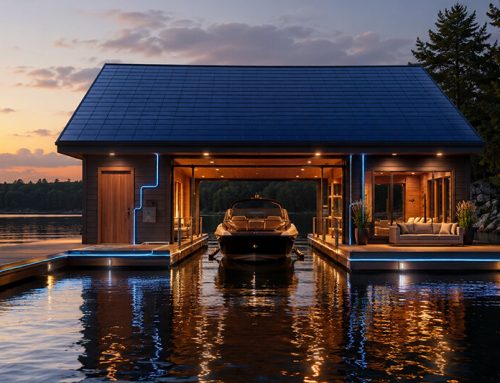
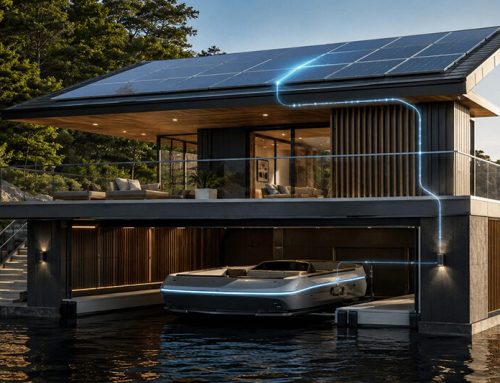
Imagine a boathouse with a dock platform that automatically lowers to launch an electric boat, then raises it to a secure storage position.
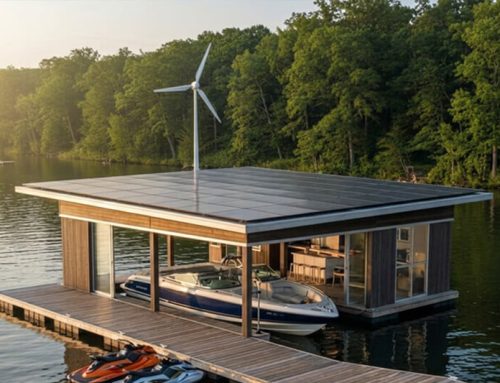
Solar shingles integrated into the boathouse roof could help generate electricity for lift operation, dock lighting, battery storage, and electric boat charging.
A future installation might also incorporate intelligent controls that coordinate several waterfront systems.
Potential innovations include:
- Automated docking assistance: Sensors and positioning systems that help guide a boat into the correct lifting position.
- Integrated solar energy management: Controls that distribute available solar-generated electricity among lift batteries, dock equipment, and boat charging systems.
- Predictive maintenance: Sensors that monitor mechanical loads, movement, and equipment performance to identify developing maintenance issues.
- Adaptable dock platforms: Modular lifting sections designed to accommodate different boats or changing waterfront requirements.
- Advanced environmental monitoring: Water-level, weather, and storm-alert systems that assist owners with equipment management and preparation.
These ideas represent potential future developments, not a single commercially available integrated system.
Combining them would require significant engineering, particularly where moving platforms, electrical equipment, waterfront structures, and boat charging systems interact.
Nevertheless, the individual technologies already emerging in modern boat lifts provide a foundation for further innovation.
Choosing the Right Boat Lift
While newer technologies offer interesting advantages, choosing the appropriate boat lift still requires careful consideration of practical waterfront conditions.
Important factors include:
- Boat specifications: Weight, length, hull configuration, and future vessel requirements.
- Water conditions: Depth, tides, currents, wave exposure, and seasonal variations.
- Dock construction: Structural capacity, available space, and compatibility with the lifting system.
- Power requirements: Electrical access, battery capacity, and potential solar charging options.
- Maintenance: Corrosion resistance, accessibility, replacement components, and service requirements.
- Regulations and costs: Local permitting, environmental restrictions, installation expenses, and long-term operating costs.
For homeowners planning a new electric boathouse, evaluating boat lift technology early in the design process can make future integration easier.
The ideal solution should balance functionality, safety, appearance, maintenance, and compatibility with evolving waterfront technology.
Conclusion: Rethinking the Modern Dock
Boat lifts are evolving beyond conventional mechanical systems into increasingly sophisticated waterfront equipment.
Hydraulic lifts, submersible platforms, floating designs, concealed lifting mechanisms, and solar-compatible systems are expanding the possibilities for modern boathouses.
Perhaps the most exciting development is the potential to combine these innovations.
As electric boating technology progresses, docks may evolve into integrated waterfront systems that support boat storage, charging, renewable energy, and automated operation.
The technologies available today offer a practical starting point, while future innovations could make the electric boathouse an even more efficient, adaptable, and sustainable waterfront environment.
What type of boat lift would you choose for your waterfront? Would you prefer a conventional lift, a hydraulic system, or a submersible platform that becomes part of your dock? Could solar power and smart controls influence your decision?
Join the discussion on The Electric Boathouse Forum and share your experiences, ideas, and concepts for the next generation of boat lifts and waterfront technology.
Are You A Professional in this Industry?
Do you have a business in this industry? Become an Electric Boathouse Trade Partner by applying today.
Related Posts