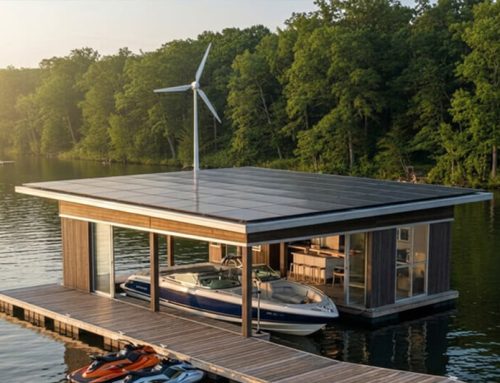
Retractable Turbines on Boathouses for Wind Energy
As waterfront design continues to move toward clean energy integration, solar has become the default solution for most boathouse projects. Wind energy is often considered next, particularly in coastal or open-water environments where airflow appears strong and consistent. However, small-scale wind behaves very differently from solar, and its success depends heavily on the conditions where the boathouse is located.
Guidance from the U.S. Department of Energy (DOE) and National Renewable Energy Laboratory (NREL) makes this clear: wind systems are highly sensitive to height, turbulence, and average wind speed. Because of this, integrating wind into a structure like a boathouse requires careful evaluation.
The idea of retractable turbines mounted on or integrated into boathouses is not a widely documented or standardized approach. It is better understood as a design-forward concept that must be tested against established wind energy principles. This article focuses on those verified principles and how they apply in a practical, real-world context.
What Actually Determines Wind Energy Performance
Wind Energy Affected by Speed and Consistency
Wind energy is not evenly available across locations. According to DOE guidance, small wind systems only become viable where average wind speeds reach sufficient levels, and expected output is calculated directly from those conditions. In practical terms, this means a site that “feels windy” is not necessarily suitable for energy production.
NREL further emphasizes that accurate performance depends not just on speed, but also on direction and variability. Consistent, unobstructed wind is far more valuable than occasional gusts.
For a boathouse, this introduces an immediate requirement: the site must be evaluated, not assumed.
Height Above Obstructions
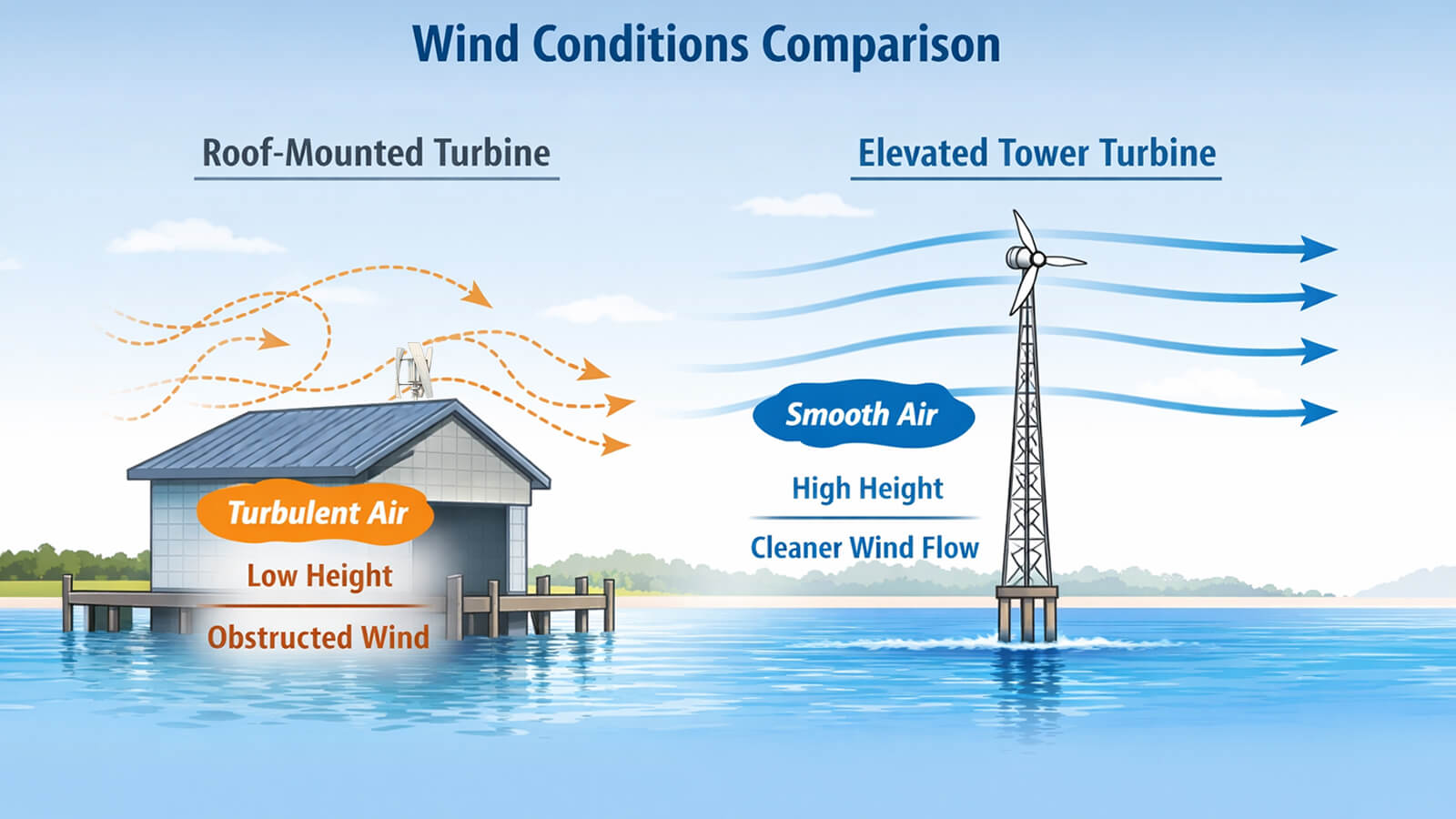
One of the most consistent findings across DOE guidance is the importance of elevation. A commonly referenced rule is that turbine blades should be positioned well above nearby obstructions, often cited as at least 30 feet above anything within a wide surrounding area.
The reason is straightforward: wind speed increases with height, and airflow becomes smoother as it clears obstacles.
For boathouses, which are typically low-profile structures, this creates a constraint. A turbine placed at roof level will almost always sit below the optimal height range, limiting both efficiency and reliability.
Turbulence Near Structures
Buildings disrupt airflow. As wind passes over and around structures, it creates turbulence—irregular, swirling motion that reduces turbine efficiency and increases mechanical stress.
DOE guidance specifically cautions against rooftop-mounted turbines for this reason. In addition to lower performance, turbulence can lead to:
- Increased wear on moving components
- Noise and vibration transfer into the structure
- Reduced system lifespan
Even in waterfront environments, where open water improves general wind conditions, turbulence can still form at roof edges, dock lines, and shoreline transitions.
Where Retractable Systems Fit
Because retractable turbines are not a standard category in DOE or NREL materials, their role must be evaluated carefully.
What Retractability Can Realistically Address
A retractable or movable system could offer practical advantages that align with known engineering practices:
- Storm protection
- Easier maintenance access
- Reduced visual impact when not in use
There is precedent for movable wind systems in the form of tilt-down towers, which allow turbines to be lowered for servicing or extreme weather conditions.
What Retractability Does Not Solve
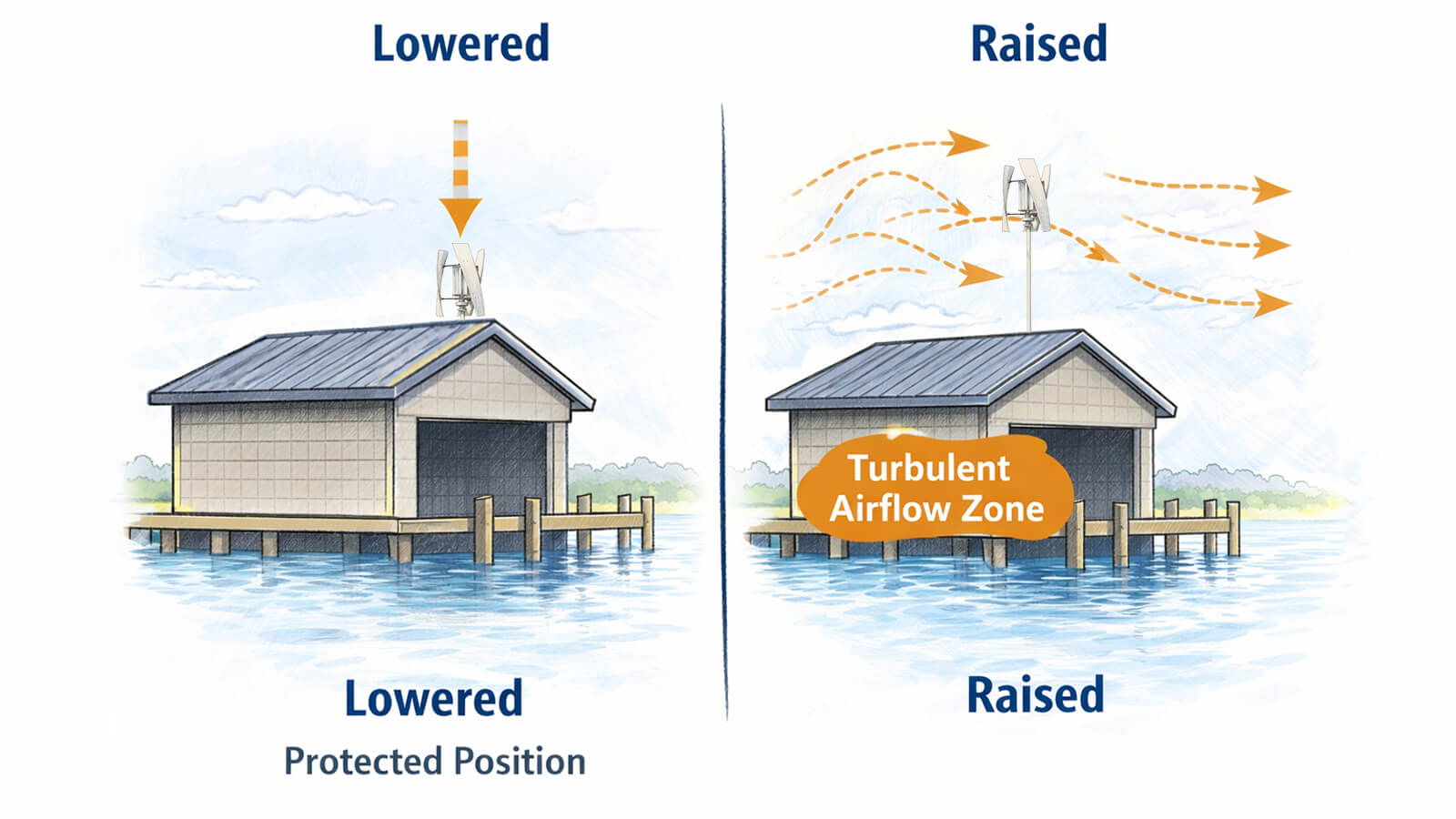
Retractability does not change the core physics of wind energy.
It does not:
- Increase wind speed at the turbine location
- Reduce turbulence created by nearby structures
- Improve energy output if the site is not suitable
If a turbine is placed too low or in disturbed airflow, making it retractable does not improve its performance when deployed.
Practical Applications for Boathouse Design
Supplemental Wind Energy, Not Primary Supply
Based on DOE guidance, small wind systems should be approached as supplemental energy sources in most residential-scale applications. Output varies widely and depends on conditions that are often outside the designer’s control.
For a boathouse, wind may support:
- Battery charging
- Lighting and controls
- Low-power systems
But it should not be relied on as a primary energy source without verified site data.
Wind Energy Integration with Solar and Storage
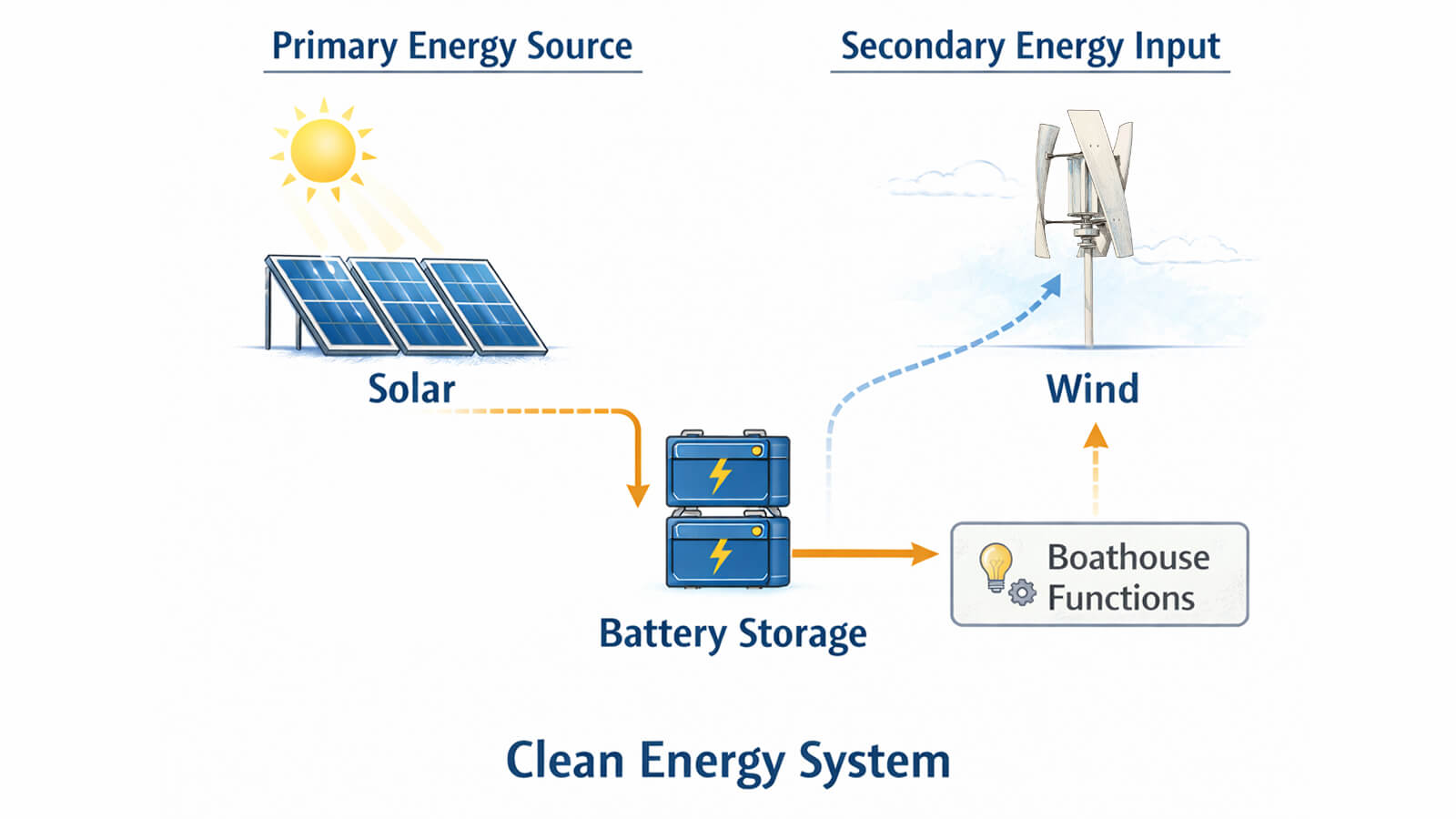
Both DOE and NREL support combining renewable sources to improve system reliability. Wind can complement solar by generating power during periods when solar output is reduced.
However, solar remains:
- More predictable
- Easier to integrate
- Lower maintenance in most cases
A practical approach is to design around solar first, then evaluate wind based on actual site performance.
Site-First Decision Making
The most important takeaway from DOE and NREL guidance is that wind systems must be selected based on site conditions.
For a boathouse project, that means:
- Assess wind resource
- Evaluate height and clearance
- Analyze turbulence
- Then determine feasibility
Without this process, wind systems are unlikely to perform as expected.
Conclusion
Retractable wind turbines on boathouses are a thoughtful concept, but not a proven standard solution. Established research from the U.S. Department of Energy and National Renewable Energy Laboratory highlights the factors that matter most: wind speed, elevation, and clean airflow.
A retractable system may improve usability, protection, and visual integration, but it does not overcome the core limitations of wind energy in built environments. For that reason, any implementation should be grounded in site-specific analysis and realistic expectations.
Well-designed boathouses will continue to prioritize reliability and simplicity—using solar as the foundation and considering wind only where conditions clearly support it. When applied carefully, wind can add value, but it should always follow the data.
Join the Discussion
Have you considered wind as part of a boathouse design, or seen a system like this in practice? Share your thoughts, questions, or experiences with The Electric Boathouse Community on our Forum and be part of the conversation around clean energy on the water.
Are You A Professional in this Industry?
Do you have a business in this industry? Become an Electric Boathouse Trade Partner by applying today.
Related Posts