Boathouse Solar & Wind System Conversions
A boathouse solar & wind system can transform how waterfront structures generate and manage energy. Boathouses have traditionally been passive structures built to protect vessels, store equipment, and provide a place to gather near the water. As electrification expands across marine environments, the boathouse solar system is becoming a practical way to generate and manage on-site power. A modern boathouse can function as a small-scale energy hub, managing energy through solar and, in some cases, wind.
Converting an existing boathouse to support renewable energy is a practical shift toward reduced reliance on shoreline utilities, lower long-term operating costs, and better alignment with electric boating and low-impact waterfront living.
This article outlines how solar and wind systems can be integrated into existing boathouses, what design considerations matter most, and where each approach makes sense in real-world use.
Understanding Boathouse Solar & Wind Systems
Most boathouse energy conversions rely on solar as the primary energy source, with wind used selectively as a supplemental input. Each technology behaves differently and understanding that relationship is essential for designing a system that performs reliably over time.
Solar as the Primary Energy Source
Solar is the foundation of most conversions. Photovoltaic (PV) Panels are reliable, scalable, and well-suited to the open exposure typical of waterfront structures.
Key advantages:
- Predictable daily production cycles
- Low maintenance requirements
- Compatibility with battery storage
- Proven performance across residential applications
Cost analyses across the U.S. energy sector consistently show that solar has become one of the most cost-competitive options for small-scale and distributed energy systems, particularly when paired with battery storage.
Wind as a Secondary Supplement
Wind can complement solar but is highly site-dependent. While waterfront locations often appear favorable, airflow is frequently disrupted by nearby structures and shoreline conditions.
Wind is best used:
- As a secondary input
- In locations with consistent, unobstructed airflow
- When turbines can be elevated above roof turbulence
In most residential boathouse applications, wind contributes incremental energy rather than serving as a primary source.
Design for Solar Integration
Solar performance depends heavily on how the system is integrated into the structure. Roof design, orientation, and shading conditions determine how much usable energy is produced.
Roof Geometry and Orientation

The existing roof is the primary constraint. Performance depends on orientation, tilt, and exposure.
Best-case conditions:
- South-facing roof
- Minimal shading
- Moderate roof pitch
If conditions are not ideal, performance can still be improved through angled mounting, higher-efficiency panels, or distributing panels across multiple roof planes.
Structural Considerations
Older boathouses may not be designed for solar loads. Before installation, evaluate:
- Roof framing strength
- Fastener compatibility
- Wind uplift resistance
In many cases, only minor reinforcement is needed, but it must be verified. Verification is essential even when modifications are minimal.
Electrical System Basics

A typical system includes:
- PV Panels
- Inverter
- Battery storage (optional)
- Charge controller (for off-grid or hybrid setups)
Hybrid systems, grid-connected with local storage, are common in boathouse conversions.
Integrating Wind Without Over Complication
Wind can be useful, but only when site conditions support it. Unlike solar, it should not be assumed viable.
When Wind Makes Sense
Wind is effective when:
- Average wind speeds are consistently above 10–12 mph
- The turbine can be mounted above obstructions
- Noise and visual impact are acceptable
Roof-mounted turbines often under perform due to turbulence. Elevation is critical.
Practical Limitations
Wind systems introduce added complexity:
- Moving parts require maintenance
- Output is less predictable
- Installation costs may outweigh benefits in marginal conditions
For most boathouses, wind should be evaluated carefully rather than assumed beneficial.
Energy Storage and Load Management
Energy demand in a boathouse is intermittent. Storage helps align energy availability with actual use.
Why Storage Matters
Battery systems allow:
- Energy use after sunset
- Load balancing during peak demand
- Backup power during outages
This is particularly valuable in waterfront environments where grid reliability may be inconsistent.
Typical Use Cases

Common loads include:
- Electric boat charging
- Lighting
- Lift systems
- Small tools or appliances
Designing around actual usage rather than maximum theoretical demand improves efficiency and cost control.
Practical Conversion Scenarios
Most boathouse conversions fall into a few common configurations.

Scenario 1: Solar-Only Retrofit
- Good sun exposure
- Roof-mounted solar
- Optional small battery
- Grid backup
This is the most common and cost-effective approach.
Scenario 2: Solar + Battery (Off-Grid Capable)
- Limited or remote utility access
- Larger battery system
- Designed for independent operation
This setup prioritizes resilience.
Scenario 3: Solar + Wind Hybrid
- Open-water location
- Elevated turbine installation
- Solar remains primary
Less common, but viable in strong wind environments.
Design Integration Matters
[Image Placement] Suggested Image: Before-and-after comparison showing poorly integrated vs cleanly integrated solar installation on a boathouse (16:9)
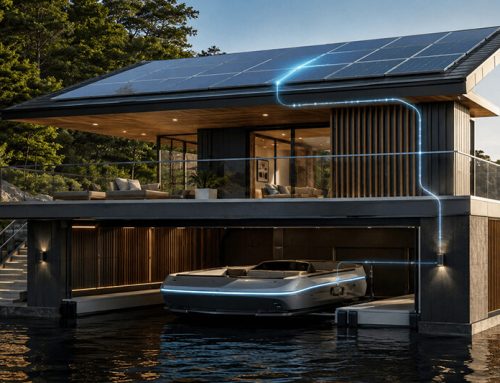
Energy systems should be designed as part of the boathouse, not added after the fact. Clean integration improves both performance and long-term usability, while also maintaining the architectural intent of the structure.
Keeping the Aesthetic Clean
A well-integrated system should feel intentional:
- Panels aligned with roof lines
- Wiring concealed where possible
- Minimal visual clutter
Planning for Future Expansion
Energy needs tend to increase over time. Plan for:
- Additional panel capacity
- Scalable inverter systems
- Expandable battery storage
Early planning reduces future modification costs.
Cost and Return Considerations

Energy upgrades should be evaluated as long-term infrastructure investments.
Upfront vs Long-Term Value
Solar requires upfront investment but offers low operating costs. Over time, savings come from:
- Reduced electricity use
- Lower fuel costs with electric boating
- Available incentives or tax credits
Wind systems require more careful evaluation due to variability in output.
Incentives and Regulations
In the U.S., incentives such as the Federal Investment Tax Credit can offset costs. Local regulations may affect:
- Structural changes
- Electrical connections
- Turbine installation
These should be reviewed early in the process.
Moving Toward Energy-Independent Waterfront Design
Boathouse conversions to solar, and selectively to wind, reflect a broader shift toward more resilient waterfront systems. Effective designs prioritize solar energy, use wind selectively, and integrate systems cleanly into the structure.
Done well, a boathouse becomes more than storage. It becomes part of a functional, low-impact energy system that supports how people actually use the water.
The most effective systems prioritize:
- Solar as the primary energy source
- Site-specific use of wind
- Clean structural integration
- Real-world usage patterns
Done well, a boathouse becomes more than storage – it becomes part of a functional, low-impact energy system.
Join the Discussion
Are you considering a boathouse conversion to solar or exploring wind integration? We invite you to join the discussion in The Electric Boathouse Forum and share your approach, challenges, or ideas with others working toward more efficient waterfront systems.
Are You A Professional in this Industry?
Do you have a business in this industry? Become an Electric Boathouse Trade Partner by applying today.
Related Posts