

New Solar Technologies
Solar technology is moving quickly, but not every promising idea is ready for real-world use. For waterfront homes, boathouses, marinas, and electric outdoor spaces, the useful question is not “What might exist someday?” It is: what can be purchased, installed, serviced, and integrated now?
Today’s most practical solar improvements are not limited to better panels. The larger shift is toward cleaner integration. Solar is becoming part of the roof, the electrical plan, the battery system, the dock, and the charger.
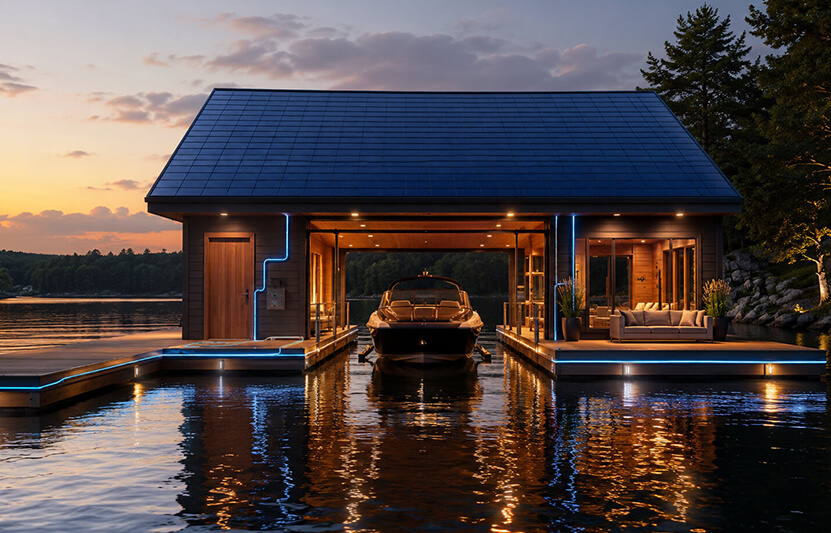
For a boathouse, that matters. Waterfront structures often need power in places where utility access is limited, expensive, or visually intrusive. The newest available solar technology is less about adding equipment after construction and more about designing the structure as a small energy platform from the beginning.
High-Efficiency Panels Are Still the Practical Standard
Traditional rooftop solar panels remain the most widely available and flexible option for most projects. Current residential panels are usually monocrystalline, meaning they use a single-crystal silicon structure to convert sunlight into electricity efficiently. Many newer panels use improved cell designs such as TOPCon or heterojunction technology, which help reduce internal energy losses and improve real-world performance in heat, partial shade, and lower-light conditions.
For a boathouse, this matters because roof area is often limited. A higher-efficiency panel can produce more energy from the same footprint, which may support lighting, lifts, battery charging, security systems, pumps, fountains, or other waterfront electrical loads.
This is still the best starting point for many solar-ready boathouses: a clean roof plane, minimal shading, planned conduit paths, and a protected equipment area for inverters, disconnects, monitoring, and possible battery storage.
Solar Shingles: A Cleaner Roofline With Real Tradeoffs

Solar shingles are one of the most design-relevant solar technologies available now. Instead of mounting framed panels above the roof, solar shingles are integrated into the roof surface. Some systems replace part of the roof. Others are designed to blend with asphalt, metal, or premium roofing materials.
The main advantage is appearance. Solar shingles can create a lower-profile, more architectural look, which may be important for waterfront homes, lake properties, communities with design review, or projects where a visible panel array is not desired. Products such as GAF Energy Timberline Solar, CertainTeed Solstice Shingle, Tesla Solar Roof, and Luma Solar show that solar roofing is no longer just a concept. It is a real option, though availability varies by location, installer network, and roof type.
The tradeoff is that solar shingles are not automatically the best technical or financial choice. Conventional panels generally produce more power per square foot and are easier to service or replace. Solar shingles often make the most sense when a new roof is already part of the project, when aesthetics are a high priority, or when the design goal is a unified roof surface rather than visible add-on equipment.
For a boathouse, solar shingles may be useful when the roof is highly visible from the home, dock, lake, or neighboring properties. They can support clean energy without making the structure look like an equipment platform. However, roof orientation, slope, shading, waterproofing, wiring access, and serviceability should be reviewed before selecting the system.
Bifacial Panels and Cleaner Mounting
Bifacial solar panels can collect light from both the front and back of the panel. They are more common in commercial and ground-mounted installations, but they are available for certain residential and specialty applications. Their benefit depends heavily on the surface below the panel. A reflective roof membrane, light-colored dock surface, or open mounting condition may help. A dark roof surface may provide little added value.
For boathouses, bifacial panels are worth discussing only when the mounting design supports them. They need airflow, reflection, and thoughtful spacing. In the right situation, they may provide an incremental production gain without increasing the roof footprint.
Modern mounting systems have also improved. Lower-profile rails, better flashing, integrated wire management, and cleaner edge detailing can make a conventional solar array look more intentional. For many projects, a well-designed panel system may be more practical than solar shingles while still looking clean and appropriate.
Smarter Inverters, Monitoring, and Control
The panel is only one part of the system. Inverters convert solar power into usable electricity, and newer inverter platforms make solar systems easier to monitor and manage. Microinverters and power optimizers can help reduce the impact of partial shading because each panel, or each small group of panels, can operate more independently.
This can matter on waterfront properties where trees, lift structures, railings, or neighboring buildings may shade part of the array at different times of day. Better monitoring also helps owners see what the system is producing and whether something needs service.
For a solar-ready boathouse, monitoring should not be an afterthought. The owner should be able to see whether solar is supporting the intended loads, whether battery storage is charging properly, and whether future additions are behaving as expected.
Battery Storage Makes Solar More Useful
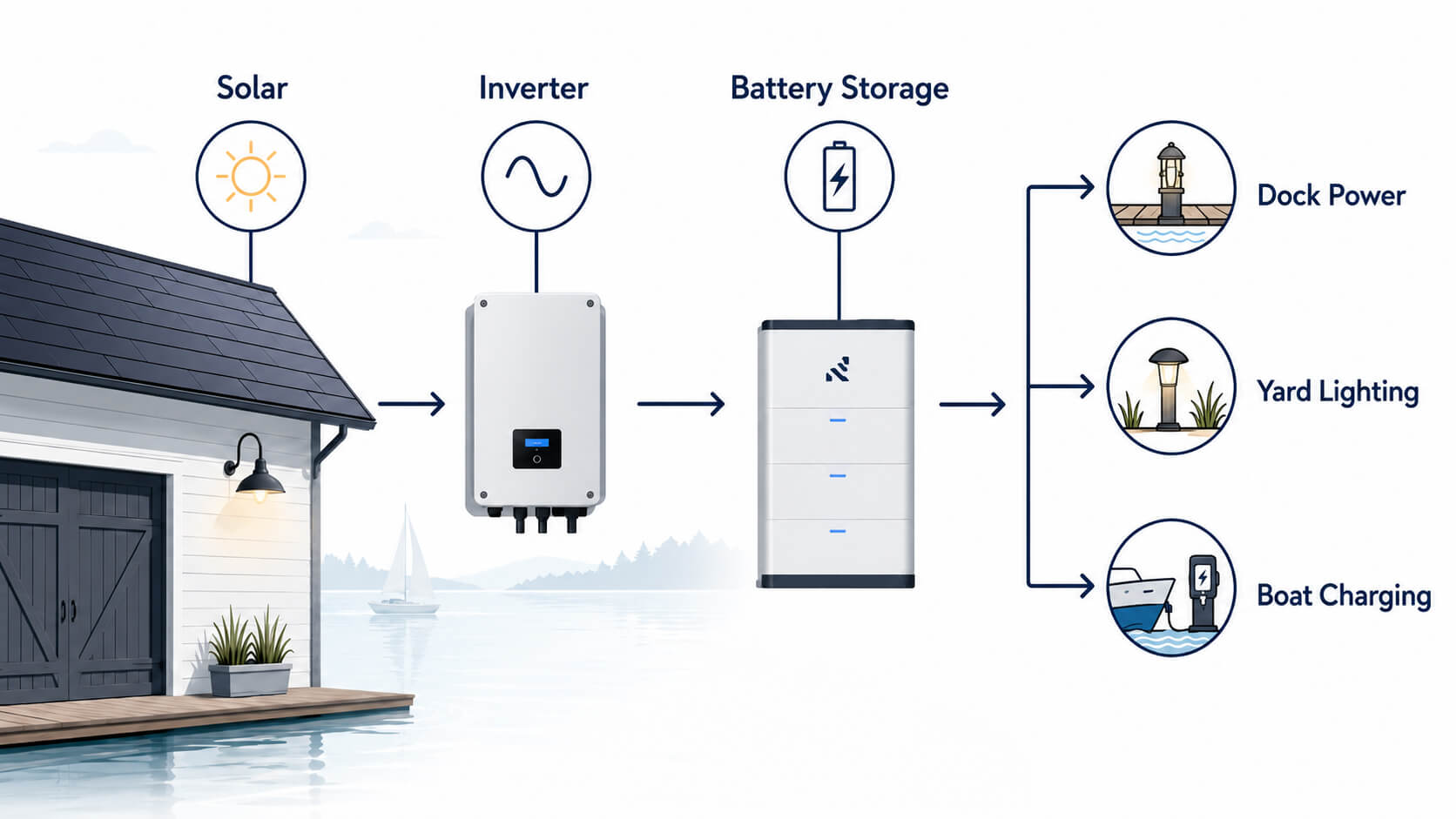
Battery storage is one of the most important current solar technologies because it changes when solar energy can be used. Without storage, solar power is strongest during daylight hours. With storage, some of that energy can be held for evening use, backup power, or off-grid support.
For boathouses, this creates practical possibilities. Solar plus battery storage may support dock lighting, yard lighting, security cameras, fountains, small pumps, communications equipment, or selected backup circuits. It may also provide resilience when utility power is unavailable or when extending a new service line is difficult.
Battery storage requires planning. It needs a dry, protected, code-compliant location with proper clearances, disconnects, labeling, and access for service. Waterfront environments are hard on equipment, so placement matters.
Solar, EV Charging, and Electric Boat Charging
The next practical step is using solar as part of a broader charging strategy. Many homes now plan for electric vehicles, and waterfront properties may also need to plan for electric boats, tenders, utility carts, or other battery-powered equipment.
Solar alone does not guarantee fast charging. Charging depends on system size, inverter capacity, battery storage, utility service, and the charging equipment itself. However, a solar-ready boathouse can be designed with conduit routes, panel capacity, equipment space, and load planning that make future charging easier and cleaner.
Bidirectional EV charging is also emerging, allowing certain vehicles and chargers to send power back to a home or grid under controlled conditions. [*10]
Conclusion
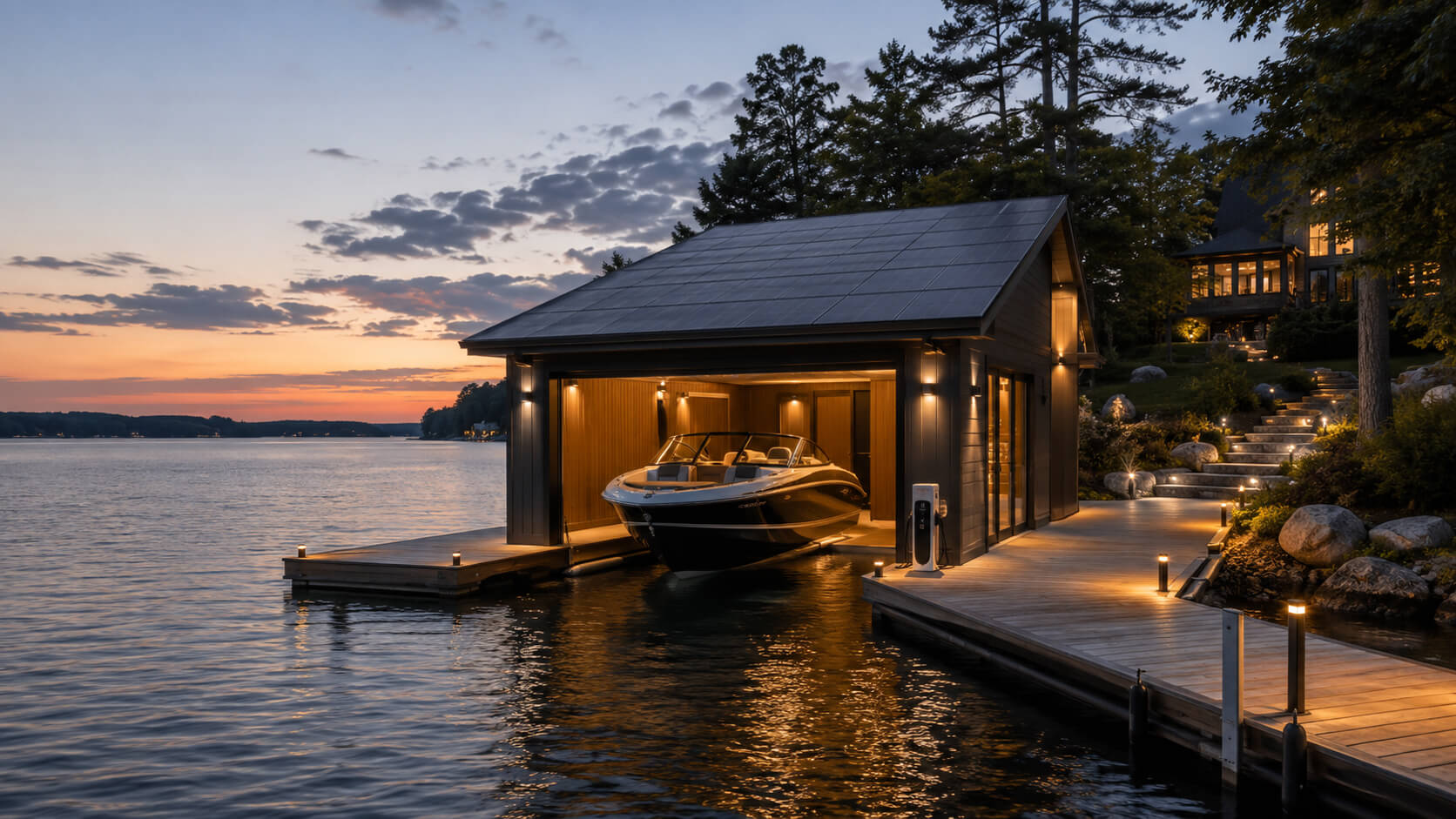
The most current solar technology is not one single product. It is a coordinated system. High-efficiency panels, solar shingles, smarter inverters, batteries, monitoring, EV charging, and future electric boat charging work best when the structure is prepared for them.
For electric boathouses, this is an important shift. Solar is no longer just a roof-mounted accessory. It can be part of the structure’s long-term power strategy, supporting everyday usability, backup power, clean charging, and a more resilient waterfront environment.
Join the discussion on The Electric Boathouse forum and share how you are thinking about solar panels, solar shingles, battery storage, and clean power for your own waterfront project.
Are You A Professional in this Industry?
Do you have a business in this industry? Become an Electric Boathouse Trade Partner by applying today.
Related Posts

Comments are closed.